Wednesday, May 13, 2015

Mr. Updike


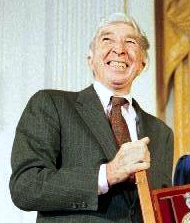
Trust Me.jpgThe other day, I finished reading The Book Thief, and, casting around for something to fill my time until I could get to the library, I picked up my copy of John Updike's short-story collection, Trust Me. John Updike. Now there's a name you haven't heard in quite a while. One of The Big Guns. The New Yorker. The Atlantic. Playboy. Born in 1932 in Shillington, Pennsylvania. Graduated from Harvard in 1954. Spent a year in England on a scholarship in Oxford. On the staff of The New Yorker from 1955 to 1957. One of only three writers to be awarded the Pulitzer Prize twice. Died in 2009.

In my early days, my preference ran to another writer named John -- John Cheever. (Whom I still recommend highly.) I had the impression that Cheever's stories were of a higher quality than Updike's, though I had never actually read any of Updike's. I assume this judgment came from what I had absorbed about Mr. Updike through nebulous remarks gleaned from reviews and book covers: his preoccupation with sex and infidelity, drinking and New England lifestyles. Not being married myself, I had little interest in the swirling interplay of personalities that made up a couple; their infidelities especially bored me. Raised Southern Baptist, I had little interest in the rutting habits of Northern Episcopalians. That a book by Updike came to rest on my shelf is due, I'm sure, merely to a casual saunter through some used-book store and a curiosity about a writer I had no real intention of reading.


John Updike with Bushes new.jpg
John Updike in 1989
That said, however, I admit I may have done Mr. Updike an injustice. The story I have just now finished -- "The Other" -- makes me think of the reddish-orange glow of sunset at the end of a warm September day. It has a feeling of languid nostalgia about it, a wistful reflection on what might soon be, tinged with a mild regret for what might have been. Yes, there is a casual, almost flippant, ambling on about carnal relationships, but there is also something shy, almost coy, with the language in which the author couches recognition of unrealized possibilities, of golden moments forever just beyond reach.

It may be that if I continue reading in this collection, I'll find all the other stories are merely disappointing variations on this same theme, redundant retellings to the point of tawdriness. My instinct, however, is to give Mr. Updike at least one more chance to prove himself. Who knows? Maybe I'll even like Rabbit Run.

Friday, March 13, 2015

Physics Phight


Several weeks ago, I came across a non-fiction book called The Fabric of the Cosmos by Brian Greene about the ultimate foundation of the Universe. Some of the fundamental assumptions made by the author seemed to need a bit more tweaking, but all in all, I found the book informative and insightful.


Then I read The Trouble with Physics by Lee Smolin which rips apart the theories underlying Fabric and disagrees on vital points with Greene as a scientist and a writer. (A 2003 TEDtalk by Dr. Smolin is here.)


I was stunned. Who would have thought there could be that much acerbic feeling between scientists? Aren't scientists supposed to be dispassionate and coldly logical? And how could there be such a vast difference of opinion between two physicists and what they see when they switch on their molecular scanners?

Part of the problem, of course, is that there are no scanners that can give us a detailed look at the smallest particles. For one thing, according to the Uncertainty Principle (or because of it, according to another way of formulation), the more precisely the position of a particle is gauged, the less precisely its momentum can be ascertained. Another glitch is in the definition of 'particle.' To physicists involved with the ultimate building blocks of the world, those blocks may not be what we as creatures in the macro-world think of as 'things'. In some sense, they may only be a quasi-metaphysical position or potential. And then there is the aspect of relationships of one particle to others in time as well as space. Whatever those two terms mean.

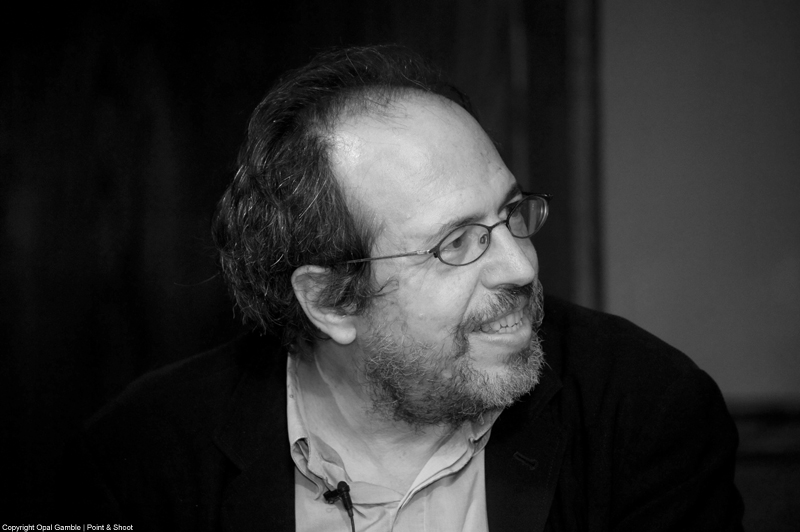
Lee Smolin
Greene views strings as the fundamental building blocks of the World-As-We-Know-It within space, time, and other dimensions, whereas Smolin goes so far as to say that "the continuum of space is an illusion" (page 240), and mentions twistor theory which states that space itself arises as an attribute of the spin of elemental particles. After all, if the simplest aspect of a particle is its spin either up or down, then the existence of the relational attributes 'up' and 'down' must depend on the existence of that particle.

Besides the pure science of the conflicting views, the two books present insights into the characters of the authors: whereas Greene presents his scenario of the string revolution as a fait accompli, Smolin offers a more flexible insight when he states that in science, it is always future generations which substantiate theories formulated by the present one.

Tuesday, March 3, 2015

Proud of My Friends

Every morning when I fire up my computer and get online, the first page I visit is the blog of Janet Reid, a literary agent  with FinePrint, an agency in New York City. Today she was responding to a question by a reader about "comp titles" -- books writers can compare their own books to as a way of showing what kind of novel theirs is. Janet's last comment was about libraries:

Librarians, like writers, are the foundation of democracy and we all need to make sure both stay strong.

So here's another shout-out to all my friends at the local library. Y'all rock!

Thursday, February 26, 2015

That Sunny Raisin


"Harlem" by Langston Hughes:

What happens to a dream deferred?

      Does it dry up
      like a raisin in the sun?
      Or fester like a sore—
      And then run?
      Does it stink like rotten meat?
      Or crust and sugar over—
      like a syrupy sweet?

      Maybe it just sags
      like a heavy load.

      Or does it explode?

 from Collected Poems. Copyright © 1994 by The Estate of Langston Hughes.

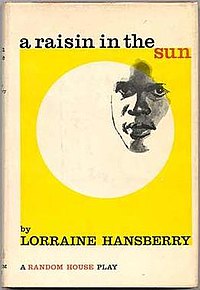
WhenFront cover of the first edition Lorraine Hansberry wrote her play, "A Raisin in the Sun," she took its title from a 1951 jazz poem by Langston Hughes. The play, directed by Lloyd Richards, had its Broadway debut on 11 March 1959, and starred Sidney Poitier, Ruby Dee, Claudia McNeil, and Diana Sands. Two years later, in 1961, it was made into a film directed by Daniel Pietrie with the Broadway cast. Both the play and the movie garnered multiple nominations and awards. Several revivals -- both on film and across the boards -- have been produced.

The story centers on the dreams and struggles of the Younger family in their bid to leave the tiny, two-bedroom apartment where they have lived for years on the south side of Chicago. Mr. Younger the elder has recently passed away, and his family anxiously waits for the insurance check to arrive. When it finally comes, the family is divided about how to use the money. The widow, to whom the check is made, wants to use the funds to move the family out of their lower-middle-class apartment building into a house of their own. Her daughter wants to use it to complete her studies for a medical degree. Her son wants to go in with friends and buy a liquor store. Her daughter-in-law wants her own son and the baby on its way to have a chance for a better life.

Scene from the play. Ruby Dee as Ruth, Claudia McNeil as Lena, Glynn Turman as Travis, Sidney Poitier as Walter, and John Fiedler as Karl Lindner.An exploration of the dreams, setbacks, and triumphs of a mid-twentieth century family, Raisin presents the American dream as the worthy aspiration of any and all citizens. However, though the daughter does aspire to the American dream in the form of a medical degree, she also becomes enthralled with the idea of her African heritage, and with Nigeria as a land of opportunity.

The kernel of Hughes' poem -- the idea of a dream deferred -- also constitutes the theme of Hansberry's play. In the poem, however, the tension of racial suppression leads to an explosion whereas in the play it leads to amalgamation. Granted, the assimilation goes against the express wishes of the white folks who own homes around the Youngers' new property, but the Youngers promise to try their best to blend in by being "good neighbors."

Though the Youngers' decision to move into the middle-class suburb is presented as a noble thing, somehow it strikes me that if they flee from the low-class apartment building to the middle-class suburbs, they might better themselves materially, but only by accepting the definition of value of the standard, white American dream. And isn't that the very thing the poem warns against? That instead of exploding in rage, the dream only sags, only stinks like rotten meat.

Monday, January 26, 2015

A Stitch in the Cosmos

The Fabric Of The Cosmos by Brian Greene
A few weeks back, I came across the Website for the television production of a show on the PBS science series Nova called The Fabric of the Cosmos. When I learned that the show was based on a book, I decided to read the book first, then watch the program. It's a good thing I did it in that order. As in most cases, the book is much better.

Brian Greene World Science Festival.jpg
Brian Greene in 2008
The author, Brian Greene, a theoretical physicist at Columbia University, espouses the theory of superstrings as the best way to describe the foundation of the universe. The theory attempts to explain all subatomic particles and fundamental forces which make up the cosmos. It tries to best Einstein by doing what the great physicist never could -- reconcile gravity, relativity, and quantum mechanics.

Einstein 1921 by F Schmutzer - restoration.jpg
Albert Einstein in 1921
Greene presents stories of the triumphs of physics from Newton to Hawking. Newton thought of space as a thing, the empty stage -- eternal and unchanging -- on which everything happens. For Einstein, however, space bends and swirls, interacting with matter and energy in ways previously undreamed of. In fact, Einstein showed that space and time are inseparable, that they make up one entity he called spacetime.

For Greene and many of his fellow physicists, spacetime is the loom upon which the fabric of the universe is woven. Instead of the classic view of atoms as "dots that are indivisible and that have no size and no internal structure," Greene explains that "these particles are not dots. In superstring theory, every particle is composed of a tiny filament of energy, some hundred billion billions time smaller than a single atomic nucleus...shaped like a little string."  No longer do we have the tiniest dots of matter that can exist; instead, we have strings that act like indivisible dots. These strings vibrate, and the difference in their rates of vibration separates one kind of string from another by giving rise to their different characteristics such as spin, mass, and charge. These aspects distinguish different types of atoms which combine to form different types of molecules which clump together to form you and me and the world.

Unfortunately for the scientists advocating superstrings as the ultimate answer to questions about the Universe, reflection on their claim undermines their argument. The problem resides not in the smallest particles of matter, but in terminology. For example, in the phrase 'a tiny filament of energy', what is energy? Maybe in some obscure tome in some dusty library of some forgotten institute, there lurks a definition of 'energy.' However, even if our respected scientific colleagues provide such a delineation, their musings are just as faith-based as those of religion.

Indeed, describing the cosmos down to its ultimate particle provides in no way a measure of value. Superstring theory cannot say anything about why a person should act in a moral way. No scientific supposition can. The moment it tries, it makes a judgment, and that is beyond the purview of science. Science explains; it cannot judge.

Nothing about superstring theory can be used to say that one should not murder. Neither can it say why a person should not lie or cheat or steal. It cannot comment on beauty. There is no way to get from the physicist's is to the good man's ought. Which is not a shortcoming of science; it's simply a limitation that should be realized. The very reason for doing science can only come about because of the moral judgment that one ought to pursue knowledge.

As for the ground of existence of the Universe, science again can say nothing because it cannot go back further than the beginning. Which is where faith plays its trump card. A scientist must have faith in Science as much as a good man must have faith in the Good. Science can say nothing beyond the fact of creation; only faith can. In the face of God, science is silent.

Sunday, December 21, 2014

Fourth Planet from the Sun


Cover image for The Martian : a novelOdysseus. Robinson Crusoe. Lemuel Gulliver. John Carter. All intrepid voyagers. All castaways. All stranded a long way from familiar shores. Add to that illustrious list Mark Watney, hero of the 2014 novel, The Martian.

Of the castaways listed, Watney, an astronaut marooned on Mars, shares the most with Robinson Crusoe. The other three spend their lost years dallying with other cultures and races; Crusoe and Watney have to endure total solitude with only their wits to keep them alive. Well, their wits plus boatloads of equipment they can salvage as they await either rescue or death. One thing that makes stories about castaways so fascinating, is that very question of whether they'll live to return home. Author Andy Weir's saga adds a new dimension to the ancient fascination: his rigorous use of cutting-edge science. Yes, the book is science fiction, but not in the same vein as Edgar Rice Burroughs' story of the Earthling-turned-Martian, John Carter, which relies much more on fantasy than it does on science. And Weir's science is solid as bedrock. No swooning Martian princesses here; no four-armed giant swordsmen; no eight-legged pets. Just an airless, desiccated planet where even a simple mistake might mean dying.

Photo of Andy Weir
Andy's site describes him as a software engineer and lifelong space nerd. With the publication of The Martian, Weir's first book, he also adds the job description of best-selling author to his resume. His crisp writing snags the reader's attention from the first sentence: "I'm pretty much fucked." How can you not want to read the next sentence?

According to The Wall Street Journal, Weir first put his book on his Website in 2011 free of charge. Later, he began selling it on Amazon for 99 cents. In three months, it sold 35,000 copies, and agents, publishers, and movie studios perked up their ears. Crown Publishers bought the book for six figures. Twentieth Century Fox optioned the film rights.

One of the best things about the novel is that it celebrates not just the adventure story of one man's ingenuity and resourcefulness in the face of overwhelming odds, but, as Watney says, "the sheer number of people who pulled together just to save my sorry ass." The epiphany of the last page comes from Watney's realization that "every human being has a basic instinct to help every other out. ... Yes, there are assholes who just don't care, but they're massively outnumbered by the people who do. And because of that, I had billions of people on my side. Pretty cool, eh?"

Yes. Way cool.

Monday, December 15, 2014

Rising Land of the Sun


Cover image for Half of a yellow sun


A few days ago, I came across a TEDtalk by an author I had never heard of, Chimamanda Ngozi Adichie. (It constantly amazes me how many authors and books are out there -- a small indication of just how huge the world really is.) After listening to Ms. Adichie's discourse, I checked out her book, Half of a Yellow Sun, from our local library. With only the vaguest idea as to what the book was about, I began reading. (This goes back to my long-held belief that the best way to experience a book is without preconceived notions, with no inkling about the book itself, other than author and genre. Otherwise, the reader risks losing the rich glow of original response. I know this seems at tautological odds with the idea of book reviews, but I look at what I offer here as the beginning of a dialogue rather than a diatribe.)

Picture credit: Akintunde Akinleye
One of the dim memories I retain from my childhood during the last half of the 1960s is the phrase used by middle-class American mothers to prompt kids to finish their meals: "Think of all those starving children in Biafra" -- as if how many peas and carrots we left on our plates would make any difference in some country on the other side of the world which we couldn't even point to on a map. What I didn't realize at the time was that literally thousands of children and their parents were being starved, stabbed, shot down, blown up, or beaten to death in the Nigerian civil war which raged between the years 1967 and 1970.


While I was holed up in my bedroom, wolfing down anything science fiction, it turns out that I missed not only socialization with my peers, but significant news events, too. One of those events was the conflict in Nigeria, one of the largest West African countries. A cousin of mine and her husband were serving as Christian missionaries in Nigeria from 1963 to 1973, but that brought the place no closer to my everyday world. I was too absorbed in myself, too oblivious. I paid scant attention to history even as it was happening on the world stage.


So the further I read into Adichie's book last week, the more my sense of bewilderment grew. When I finally realized what the story was about, that realization stunned me. It was only then that I pieced together the name Biafra and those half-forgotten memories, and applied the results to the book I had in front of me.

According to Wikipedia, Nigeria is inhabited by over 500 distinct, sometimes warring ethnic groups, including the Hausa and Igbo peoples. The action of Adichie's novel ignites from a mass murder of Igbo by Hausa, leading up to the declaration on 30 May 1967 of the independence of a chunk of the southeast of Nigeria to be known as Biafra, and to serve primarily as a refuge for Igbo. The story centers on an Igbo woman, Olanna, and her family. They start off as well-to-do, middle-class, highly educated people; the narrative follows them as the war forces them out of one home after another, constantly leaving behind more and more possessions, sinking lower and lower on the economic scale, mirroring the effects of Nigeria's embargo on Biafra itself.

Adichie excoriates the white colonial mentality which drove exploration/exploitation from the 15th through 20th centuries. Early in the book, one of the characters rails about being "a Nigerian because a white man created Nigeria." At the Berlin Conference of 1884, the European powers divided up what they termed 'the Dark Continent.' In drawing what they thought should be national boundaries, Britain, Russian, and other colonial powers completely ignored the reality of tribes which had existed for thousands of years with their own histories, their own mandates of allies and enemies, with the results turning out not unlike trying to stuff a dozen cats into a broom closet.

By telling her tale through the eyes of characters intimately involved in the secession attempt itself, Adichie reveals in a more compelling way than any history book could, the multitudes of reasons the white man's plan would only produce resentment and exacerbate tribal conflicts. It was exactly the same story Europeans had tried/were trying with the indigenous peoples on the American continents. One of the most telling quotes comes from an old tribal man who says to a European,  the "people of Igboland do not know what a king is. ... It is because the white man gave us warrant chiefs that foolish men are calling themselves kings today."